
Interior
Fireplace Surrounds & Chimney Cladding
The one wall in the room everybody looks at — and the one where format choice shows up most.
Fireplaces in South Florida are almost entirely decorative, which Miami Stone Veneer Specialists thinks is an argument for spending more on the surround, not less. Nobody's buying heat. They're buying the thing the sofa points at.
Clearances, briefly
The stone is non-combustible concrete, so it isn't the constraint. The appliance is. Every gas insert ships with a clearance-to-combustibles spec that governs how close framing, adhesive, and mantel material can sit to the opening.
Inside that zone: non-combustible backer board and a rated setting material. Outside it: normal veneer install. Get the manual, follow it, and this is a non-issue. Ignore it and you have a code problem and an insurance problem.
The vertical repeat problem
A floor-to-ceiling chimney breast is a tall, narrow surface — maybe three feet wide and twelve feet high. That geometry is unforgiving. A face with only two or three formats will visibly stack the same pattern up the wall, and because the eye travels vertically, you notice immediately.
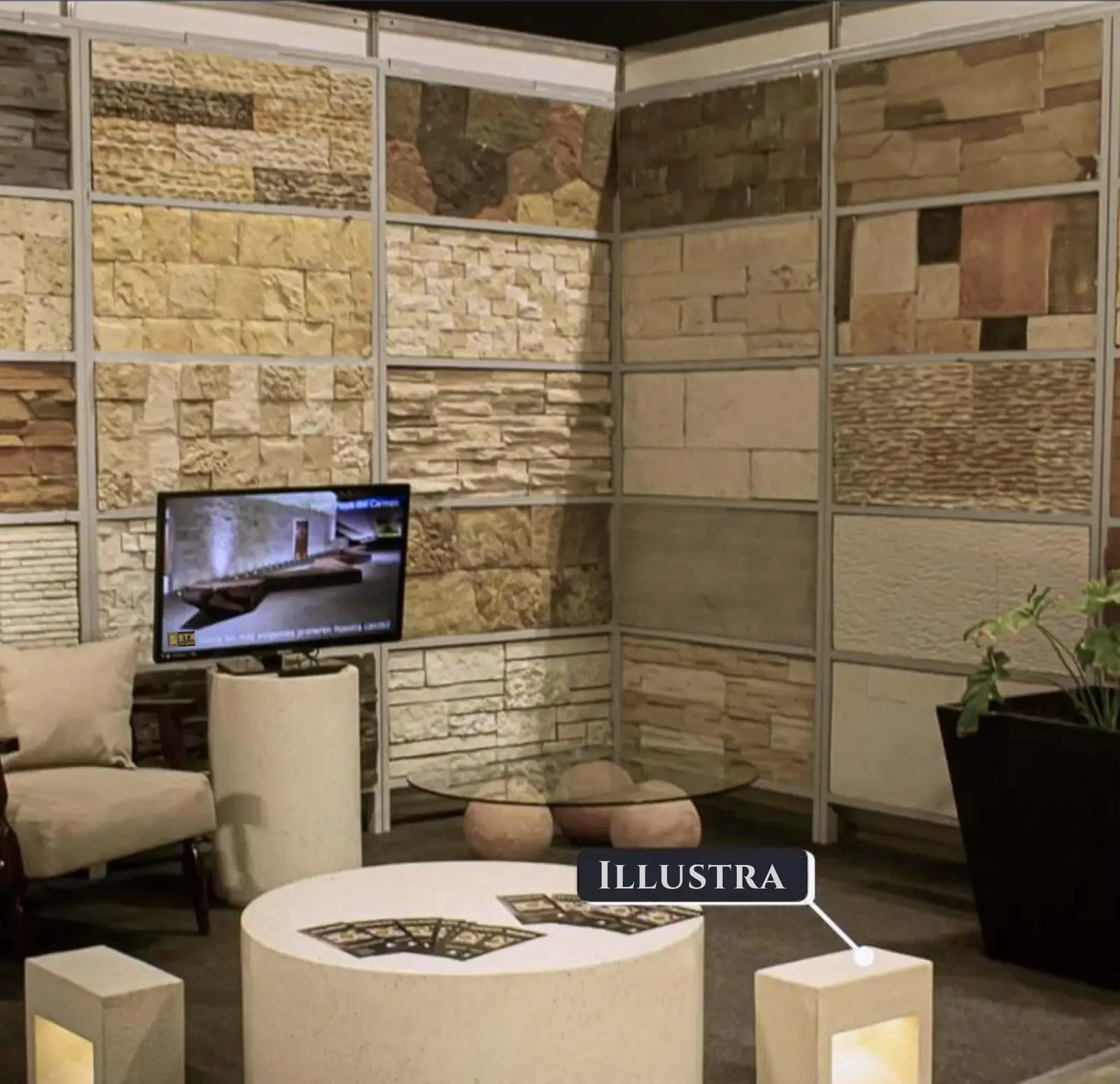
Use a collection with real size variation. Rustic Stone carries six formats. Royal II has three with genuine colour movement. Both break the vertical rhythm. A single-format stacked profile on a tall breast is the one combination we'd talk you out of.
Mantel and returns
Two details that separate a good surround from a builder-grade one:
- Corner pieces at the returns. A chimney breast projects into the room, so it has outside corners. Mitred field stone shows its thickness. Order corners.
- Mantel bearing. Decide before the stone goes up. A floating timber or concrete mantel needs steel pins set into the substrate, and retrofitting those means cutting the finished face.
What it costs
A standard surround is 40 to 80 square feet — $450 to $1,400 in material. A full floor-to-ceiling breast is 120 to 200 square feet, so $1,300 to $3,600. Add corner pieces by linear foot.
Products specified for this
Stacked Stone
The most-specified profile we sell. Long, low courses that read as a clean horizontal band — the look behind most modern Miami feature walls and outdoor kitchen islands.
View details →Rustic Stone
Deep relief and heavy texture for elevations that need weight. Six-size ashlar mixes through to 24-inch quarried panels.
View details →Royal Stone
Quieter than our rustic range. Honed, low-relief faces that suit interior walls and contemporary exteriors where texture should whisper.
View details →Cantera
Cantera is the stone of colonial Mexico — and it reads beautifully in Coral Gables and Coconut Grove. Three lengths, plus a sandblasted variant with real open pores.
View details →Related applications
Interior Accent Walls
Miami condo owners can't touch the exterior, so the accent wall does the work. Lightweight formats that go over drywall without structural changes.
View details →Entryways
The entry is the smallest area with the biggest return. A few hundred square feet of the right stone changes the whole elevation.
View details →Feature Walls
When the wall is the point. Deep-relief panels, lattice screens, and large-format stone specified for maximum effect.
View details →Worth reading first
Stone Veneer Cost in Miami
Material, labour, prep, and sealer — broken out separately so you can see where the money actually goes.
View details →How to Choose Stone Veneer
Most people start with colour. That's the fourth decision, not the first. Here's the right order.
View details →Stone Veneer Maintenance
Ninety percent of stone failures we see trace back to one of four maintenance mistakes. All four are avoidable.
View details →Common questions
Is manufactured stone safe around a firebox? +
The stone body is non-combustible concrete. What governs the install is the appliance manufacturer's clearance-to-combustibles, which applies to the framing and the adhesive behind the stone, not the stone itself. Follow the appliance spec and you're fine.
How close to the opening can it go? +
That's set by the appliance, not by us — typically 6 to 12 inches for a gas insert. Inside that zone you need non-combustible board and a rated setting material. Your installer should have the manual open while they work.
Do people still put fireplaces in Miami houses? +
More than you'd think, and almost all of them are gas or electric decorative units. Nobody here needs the heat — they want the focal point. Which means the surround is doing all the work, and that's a reason to spend on the face rather than the firebox.
What about a full floor-to-ceiling chimney breast? +
Very popular, and it's where the format choice really shows. On a 12-foot run you need a face with enough size variation that the repeat doesn't stack up vertically. Rustic Stone or Royal II rather than a single-format profile.
Talk to us about fireplaces
Samples, take-offs, and pricing for projects across Miami and South Florida.